Every lawn is unique, each one requiring different levels of care depending on its soil, local growing conditions, and grass type. In this lawn care calendar, we’ll show you how to maintain a bermudagrass lawn month by month.
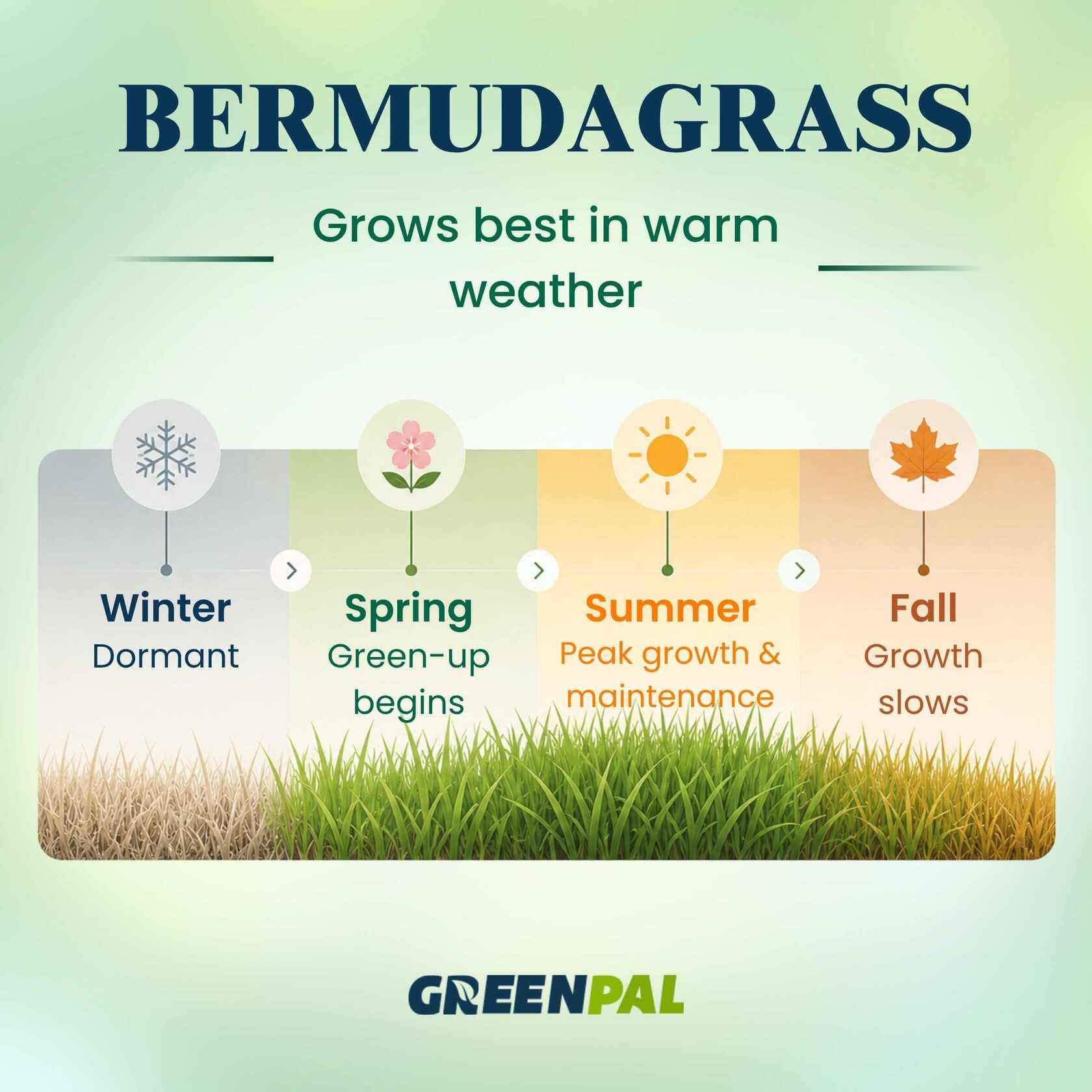
Bermudagrass is a warm-season grass common throughout the Southern United States and transition zone. Unlike cool-season grasses, which require the most care in early spring and early fall, bermudagrass requires the most attention late spring through summer.
▲ marks the best time to perform the designated task.*
△ marks an acceptable time to perform the designated task.*
Jan |
Feb |
Mar |
Apr |
May |
Jun |
Jul |
Aug |
Sept |
Oct |
Nov |
Dec |
|
Winter |
Spring |
Summer |
Fall |
|||||||||
Irrigation |
△ |
▲ |
▲ |
▲ |
△ |
|||||||
Mowing |
△ |
▲ |
▲ |
▲ |
▲ |
▲ |
△ |
|||||
Fertilization |
▲ |
▲ |
▲ |
▲ |
△ |
|||||||
Dethatching |
▲ |
▲ |
△ |
|||||||||
Aeration |
▲ |
▲ |
△ |
|||||||||
|
Seeding |
▲ |
▲ |
||||||||||
|
Overseed (with ryegrass) |
△ |
▲ |
||||||||||
Preventative grub control |
▲ |
▲ |
||||||||||
|
Pre-emergent herbicide |
Soil temp 50 - 55°F |
Soil temp 50 - 55°F |
Soil temp dropping toward 70°F |
Soil temp dropping toward 70°F |
||||||||
|
Fungicide (spring dead spot) |
Soil temp 60 - 75° F |
*Timing will need to be adjusted based on the region where bermudagrass is grown and the year’s forecasted first and last frost dates.
Spring: March, April, May
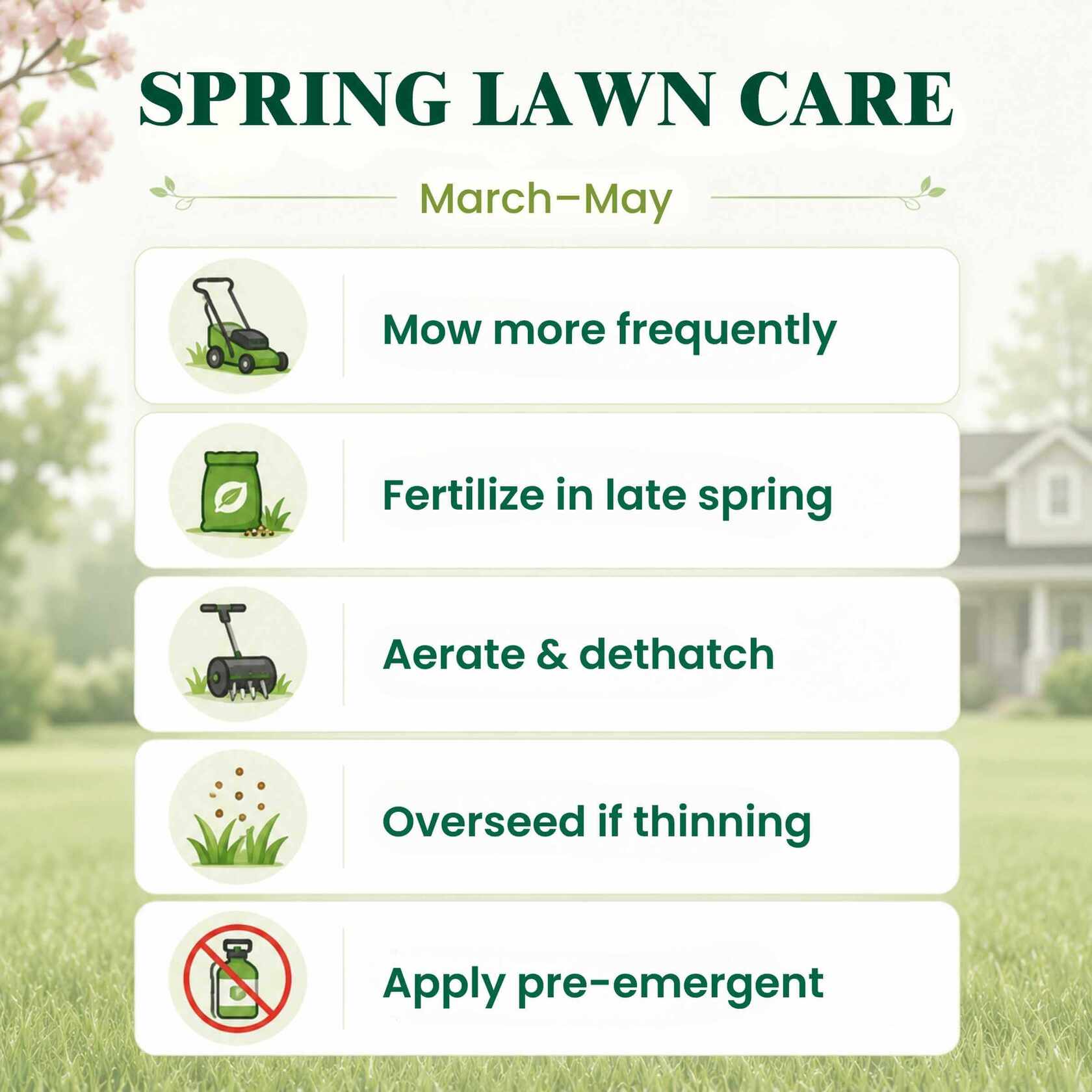
As temperatures start to warm in mid-spring, bermudagrass begins to green up and exit dormancy. With growth increasing around late-spring, prepare to mow more frequently and apply fertilizer. And — depending on your lawn’s condition — aerate, dethatch, and overseed.
Here’s how to care for bermudagrass in spring:
Remove Dead Tissue
Right before spring greenup, mow the lawn or rake the grass to remove dead winter tissue. Gently combing the grass with a leaf rake also helps to loosen matted grass and break down snow molds that developed over winter.
Mowing
After spring greenup, bermudagrass begins to grow more rapidly as temperatures rise, requiring frequent mowing.
Bermudagrass for lawns prefer mowing heights between 1 and 1.5 inches. Avoid removing more than one-third of the grass blade’s height in a single mow, as this can shock your turf. That means, bermudagrass ought to be mowed when heights reach between 1.5 and 2.25 inches.
Learn More:
Irrigation
In most regions of the United States, spring rainfall provides enough water for lawns. Provide supplemental irrigation during droughts or when the grass shows signs of thirst.
Weed Control
If your lawn has a history of summer weeds, pre-emergent herbicide can help prevent new weeds from growing.
Apply pre-emergent in early to mid-spring when soil temperatures are consistently between 50 and 55°F.
Learn More: When to Apply Pre-Emergent Herbicide
Note: Some pre-emergent herbicides prevent grass seeds from germinating. Read the product’s labeled instructions to determine the wait time between application and planting new grass seed (which can be several weeks).
Monitor for Disease
Spring dead spot is a destructive lawn disease affecting bermudagrass.
Prominent symptoms appear when dormant grass greens up in early spring, usually appearing as bleached spots of dead grass ranging from 6 inches to several feet in diameter. Affected patches may appear sunken compared to the surrounding healthy turf.
These symptoms result not from the disease itself, but from the winter injury it makes the grass susceptible to after infecting the lawn in fall.
If your bermudagrass lawn is suffering from dead spots this spring, combine cultural management (a proper lawn care routine) with preventative fungicides in the fall.
Thatch Removal
The best time to dethatch bermudagrass is in late spring or early summer.
Due to its aggressive growth habit and rapid production of stolons and rhizomes, bermudagrass is susceptible to developing excessive thatch. Once thatch exceeds one-half inch thick, it needs to be removed.
Verticutters are best for bermudagrass lawns — in addition to pulling up thatch, verticutters slice through stolons, thin the lawn’s density, and encourage upright growth.
Tip: If dethatching and aerating in the same season, dethatch before aerating.
Learn More: Why, When, and How to Dethatch Your Lawn
Aeration
The best time to aerate bermudagrass is in late spring or early summer.
Like dethatching, aeration is an invasive treatment, and your lawn may need a whole growing season to recover. If you wait to aerate until late summer, your lawn may not have enough time to heal.
Tip: If dethatching and aerating in the same season, aerate after dethatching. Followup aeration with overseeding or fertilizer, if necessary.
Learn More: Why, When, and How to Aerate Your Lawn
Overseeding
If your bermudagrass lawn suffers from winter damage or is thinning, plant new grass seed over your existing lawn.
The best time to overseed bermudagrass is late spring or early summer.
To ensure your grass seed has the best chance for success, you’ll need to find a good window of opportunity. Here’s how to maximize your overseeding timing:
Overseed after aeration.
Allow the recommended time gap between herbicide applications and seeding.
Wait 4 to 6 weeks before applying a nitrogen-heavy fertilizer.
Fertilization
Fertilize and add soil amendments, such as lime and sulfur, based on soil test results. If you haven’t tested your soil, spring is a good time to do so.
Bermudagrass generally benefits from 0.5 to 1.0 pounds of nitrogen per 1,000 square feet several weeks after it turns fully green — typically in late spring (May).
Do not apply nitrogen too soon. If fertilizer is applied in early spring to encourage dormant grass to green up, an unexpected late frost can significantly damage the lawn.
Tip: For best results, fertilize after aeration. However, do not overseed and apply nitrogen fertilizer at the same time.
Summer: June, July, August
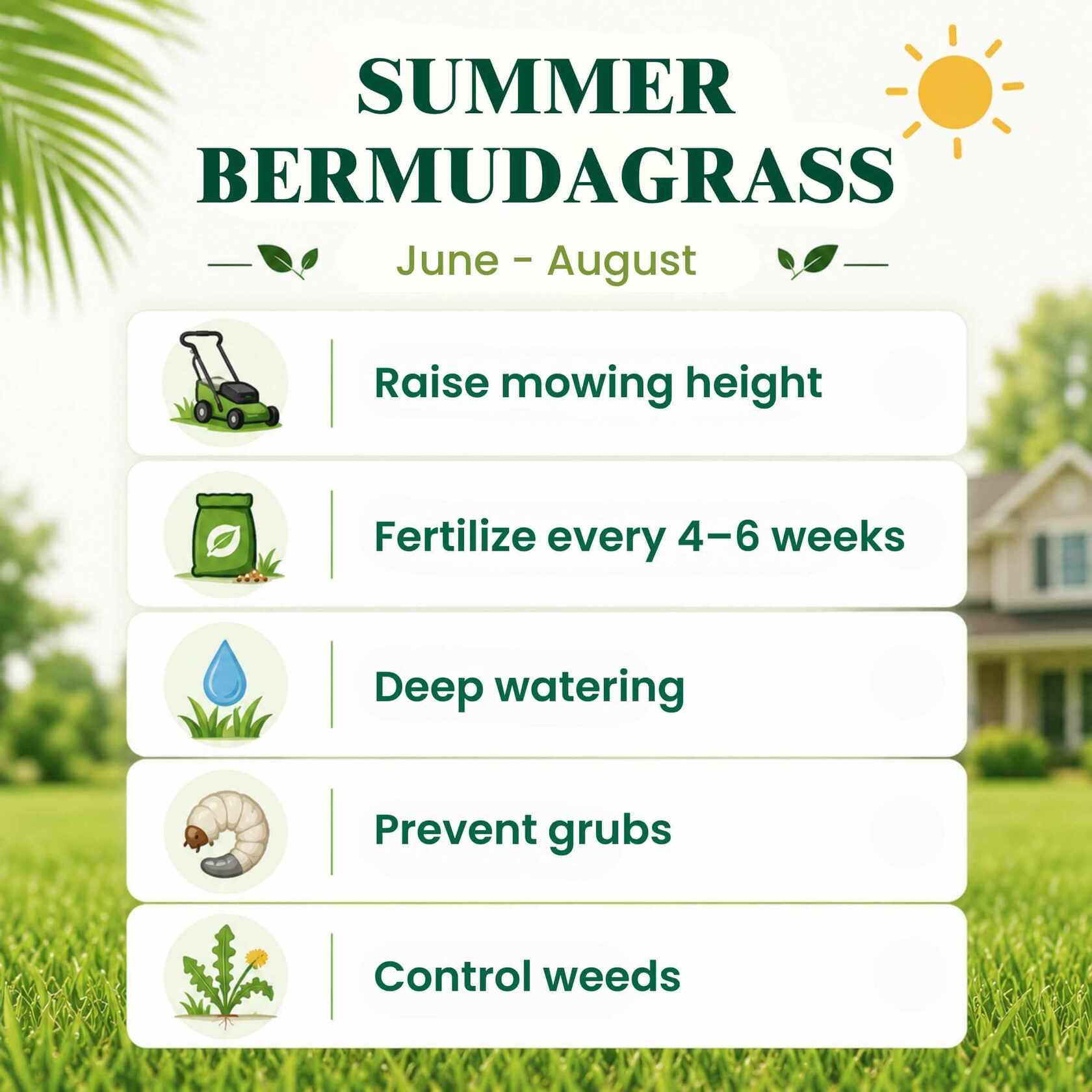
Early summer is your last chance to dethatch, aerate, or overseed if you missed the late-spring window.
Bermudagrass grows rapidly in summer, requiring mowing approximately twice per week. Prepare to break a sweat mowing, fertilizing, and irrigating.
Raise Mowing Height
As late spring transitions into early summer, raise the mowing height to 1.5 inches. Taller grass shades the roots and helps retain soil moisture.
Fertilization
Base your summer fertilizer applications on the results of a soil test. Generally, bermudagrass benefits from 0.5 to 1.0 pound of nitrogen per 1,000 square feet every 4 to 6 weeks.
Learn More:
Irrigation
Bermudagrass needs 1 to 1.25 inches of water per week during the active growing season. During dry spells, ensure your lawn is receiving enough supplemental irrigation.
Pest Control
If your lawn has a recent history of white grub infestations, the best time to apply preventative insecticides is generally June or July, before the eggs hatch in mid-to-late July.
Refer to the product’s instructions for recommended timing, as the application window can vary depending on the active ingredient.
If your region has a history of high white grub activity, a local landscaping professional — such as those serving Pittsburgh or San Antonio — can help keep your lawn healthy and resilient against grub damage.
Weed Control
If needed, control summer weeds with post-emergent herbicides, hand-pulling, digging, or homemade weed killers.
Learn More:
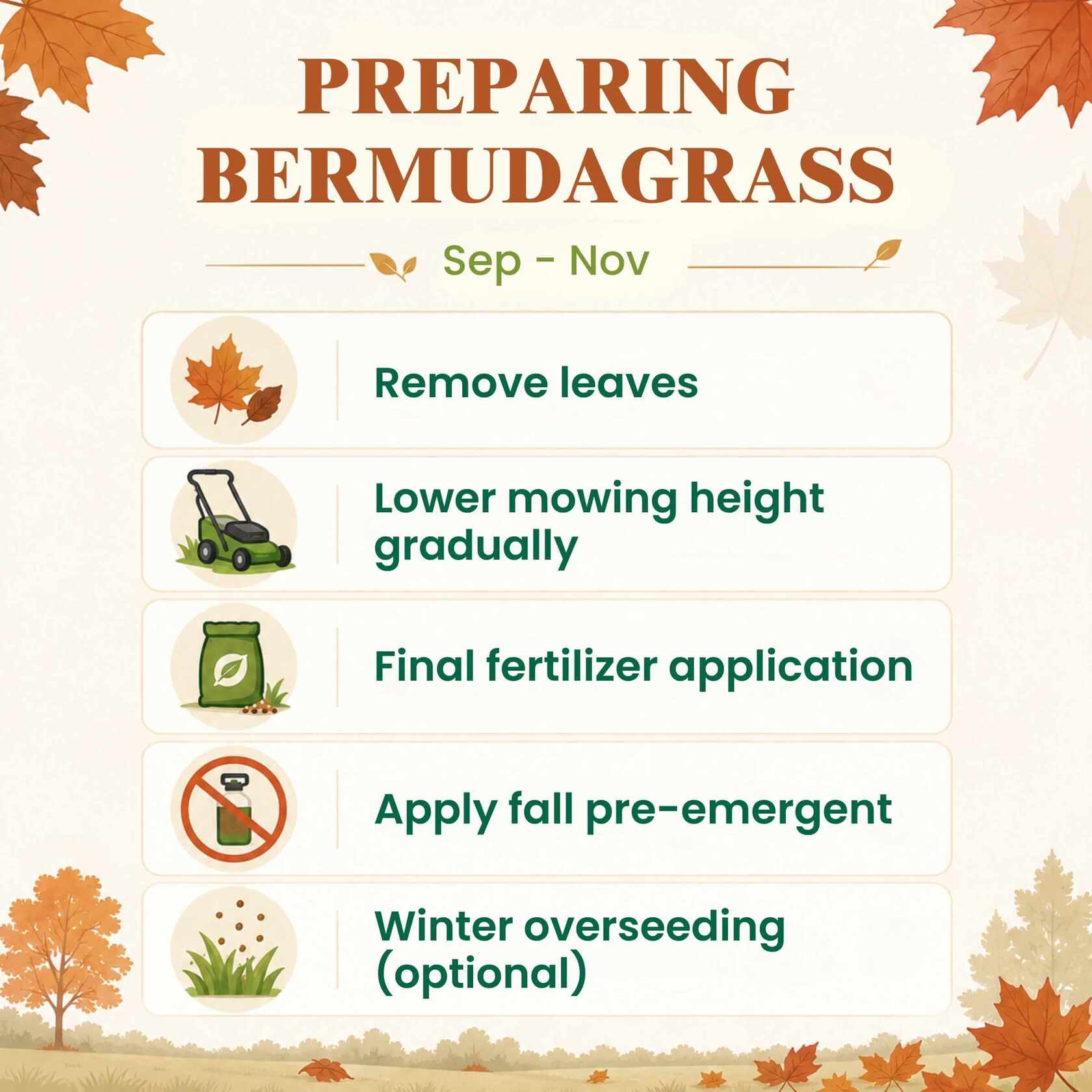
Fall: September, October, November
As temperatures drop in autumn, your bermudagrass’s growth will also slow down — and so will your lawn care chores.
Fertilization
A soil test may recommend one final fertilizer application of 0.5 pounds of nitrogen per 1,000 square feet in mid-August to early-September.
Perform this last application no later than 6 weeks prior to your region’s average first frost date.
Note: Apply lime and sulfur as needed in early fall, according to soil test recommendations.
Irrigation
Autumn typically provides enough rainfall for turfgrass. However, if your lawn is showing signs of drought stress, provide it a supplemental drink.
Weed Control
To prevent weeds from invading your lawn in winter (such as dandelions or chickweed), apply pre-emergent herbicides in early to mid-fall when soil temperatures drop and begin approaching 70°F.
Remove Leaves
Removing autumn leaves is an important part of healthy lawn care. When too many leaves collect on the lawn, they block sunlight and suffocate turf. Leaves can also spread pests and fungal diseases, especially when wet.
Leaf removal methods include raking, leaf blowing, mulch mowing, or professional leaf removal services.
Lower Mowing Height
As winter approaches and the grass growth starts to slow, gradually lower the mowing height to 1 inch. Short grass is less susceptible to winter injury than tall grass.
Do not cut the grass short all at once. Gradually lower the mowing height to avoid removing more than one-third of the grass blade’s height in a single mow.
Disease Control
Some diseases, like spring dead spot, are active in the fall but don’t show visible damage until spring. If your lawn has a history of spring dead spot, applying preventative fungicides about one month before dormancy can help prevent damage next spring.
Timing Tip: According to the University of Georgia, research has shown that one application of fungicide in the fall when soil temperatures are between 60° and 75° F can help control spring dead spot. If a second application is necessary, apply 4 to 6 weeks later.
Winter Overseeding
Bermudagrass and other warm-season grasses lose their green color in late fall to early winter as temperatures drop. If you’d like to extend your lawn’s green color into the cooler season, overseed your lawn with annual ryegrass (a cool-season grass) in mid-fall.
Note: Do not apply a pre-emergent herbicide if you are planning to overseed in the fall.
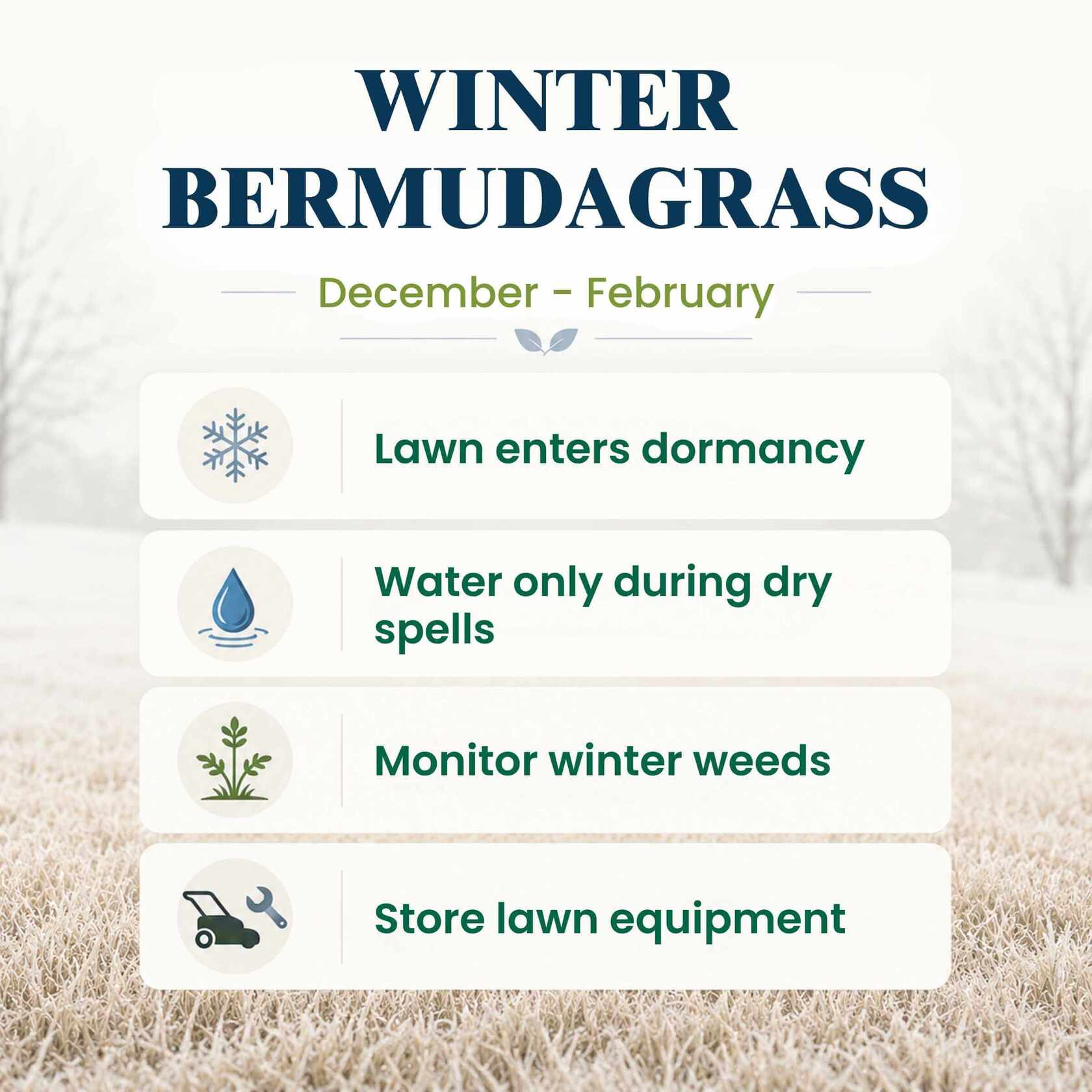
Winter: December, January, February
Winter is where you get to relax. Growth stops as your lawn enters dormancy and prepares to survive the winter, leaving less work for you.
Here’s how to take care of bermudagrass in winter: put away the fertilizer and lawn equipment, and keep an eye out for dry spells and weeds.
Irrigation
Lawns need very little water in winter, and can usually survive off precipitation and snowfall during this time. However, if it hasn’t snowed or rained in 3 to 4 weeks, apply 0.25 to 0.5 inches of water when the soil is not frozen.
Weed Control
If necessary, apply a post-emergent herbicide to winter weeds, such as dandelions and chickweed.
Hire a Lawn Care Professional
Bermudagrass is a high-maintenance turf, typically needing frequent fertilizer applications, thatch removal, and mowing.
Due to bermudagrass’ fast growth, it’s easy to fall behind on its mowing requirements. However, this risks removing more than a third of the grass blade when you finally catch up. To stay on schedule and protect your lawn’s health, consider hiring a local lawn mowing professional for the job.