

Check out these other Articles

John Deere Q850R Review: Why the 7-Iron PRO Deck Stands Out in Wet Conditions
- by
- Gene Caballero
- September 17, 2025
Weekly vs. Biweekly Lawn Service: When Do Pros Make the Switch?
- by
- Gene Caballero
- September 12, 2025
Ultimate Guide to 2-Stroke Fuel Mixing for Landscaping Pros
- by
- Gene Caballero
- August 30, 2024

Product Liability Insurance vs. General Liability Insurance for Landscaping Companies
- by
- Gene Caballero
- March 19, 2024

9 Powerful TikTok Strategies to Grow Your Lawn Care Business
- by
- Gene Caballero
- March 13, 2026

6 Best Route Planning Applications for Lawn Care Companies
- by
- Gene Caballero
- June 08, 2024
Subscribe for our latest articles
NEED TO KNOW
- GreenPal, LawnStarter, and Thumbtack are popular TaskRabbit alternatives for lawn care professionals looking for better pricing and recurring clients.
- GreenPal offers low commission fees, route optimization, recurring scheduling, and faster payouts for lawn care businesses.
- Choosing the right lawn care platform depends on your goals, local market, pricing model, and the type of lawn services you provide.
If you're a lawn care professional looking for a better alternative to TaskRabbit in 2026, you have several options, but they're not all built for the same type of business. Some charge commission, some charge per lead, and some run on a flat subscription. The differences in fees, tools, and business model add up fast.
We're GreenPal. We've connected over 1 million homeowners with more than 60,000 lawn care pros across 48+ states, so we know what professionals need from a platform. We also know we're one of the options being compared here, and we think the breakdown speaks for itself. GreenPal's 5% commission, built-in route optimization, and recurring scheduling tools make it the strongest fit for most lawn care businesses, but the right choice depends on where you are and what you're building toward.
Here's what we found when we compared the leading alternatives side by side.
Why TaskRabbit Doesn't Work Well for Lawn Care Pros
TaskRabbit was designed for general household tasks and handyman jobs. That creates several structural problems when you try to run a lawn care business on it.
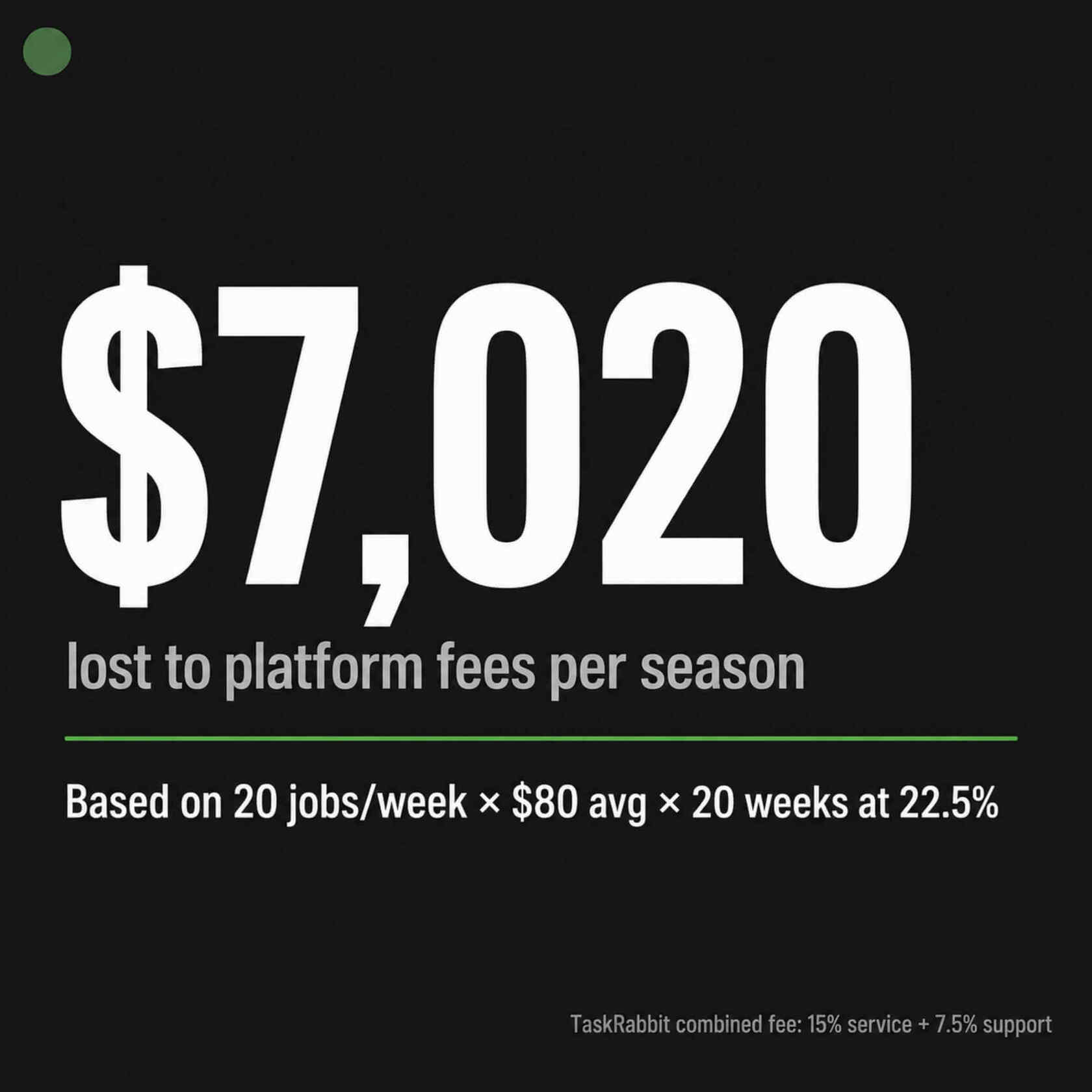
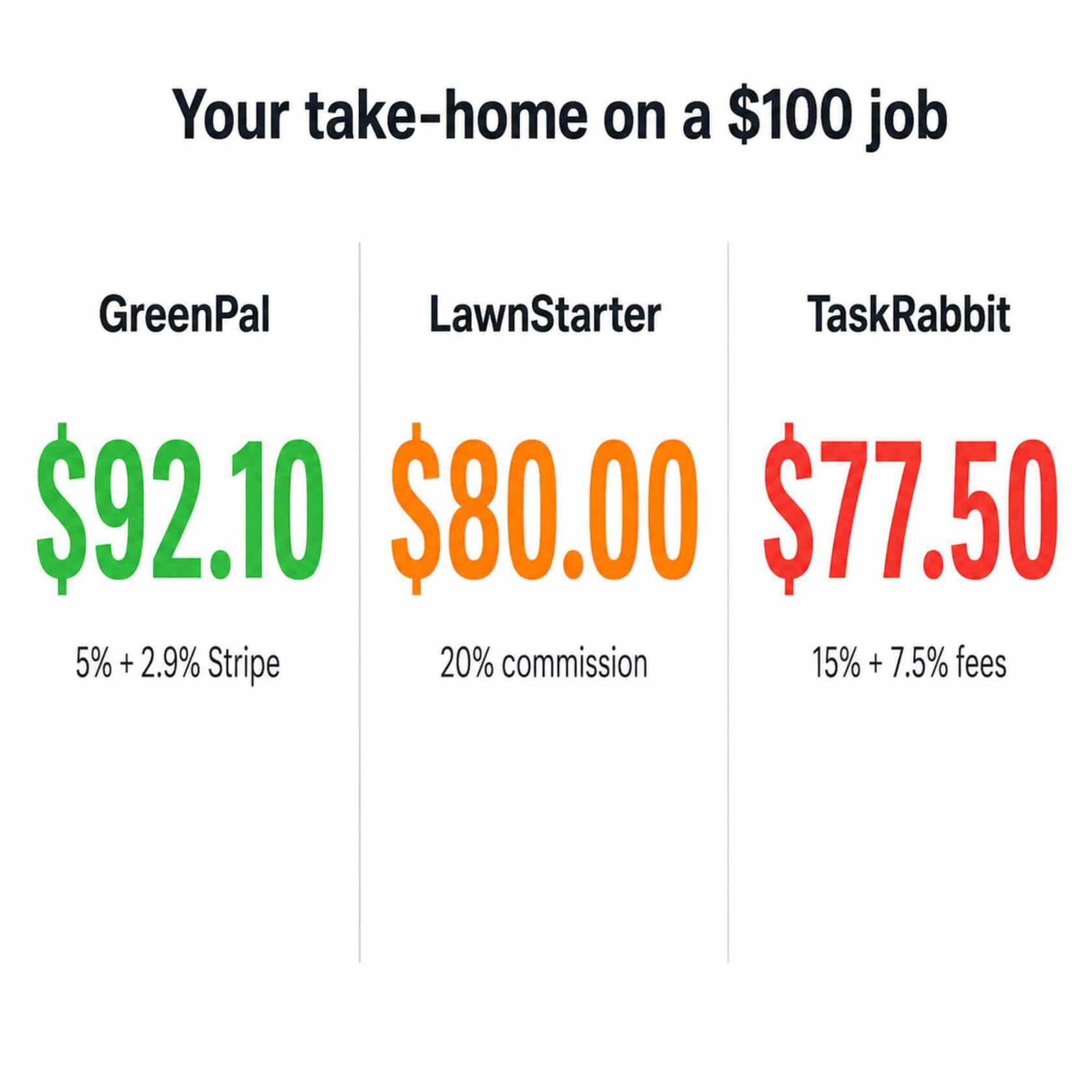
The fee structure is punishing. TaskRabbit charges a 15% service fee plus a 7.5% support fee, totaling 22.5% per transaction. On a $100 mowing job, that leaves you with $77.50. For a pro doing 20 jobs a week at an $80 average, that's more than $7,000 in platform fees over a 20-week season.
It runs on hourly billing. Lawn care is almost universally priced as a flat fee per property. Efficient crews using commercial equipment can mow and trim a standard residential lawn in under 30 minutes. Hourly billing penalizes productivity and makes your per-job revenue unpredictable.
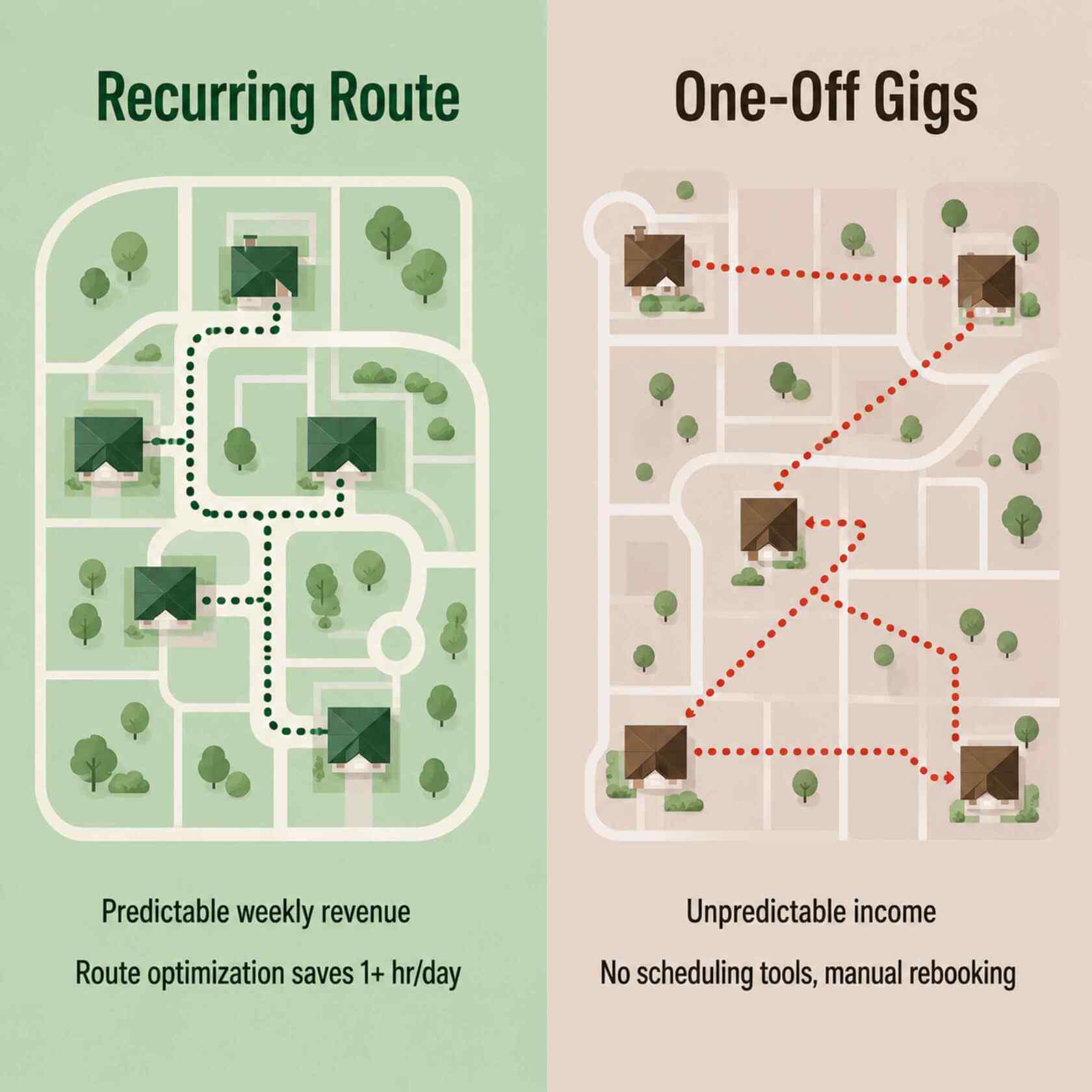
There are no recurring service tools. Managing a route of 30 or 40 weekly clients requires automated scheduling, not manual rebooking. TaskRabbit treats every job as one-off, which doesn't match how profitable lawn care operations actually run.
Coverage is concentrated in major metros. TaskRabbit's marketplace is thinner in suburban and rural markets, which is exactly where a large portion of residential lawn care demand lives.
The Best TaskRabbit Alternatives for Lawn Care Pros
1. GreenPal
GreenPal was built specifically for lawn care, which matters more than it might sound. Our CEO, Bryan Clayton, ran a landscaping company for 15 years before building the platform, so the tools were designed around how this work actually gets done.
The most immediate advantage for professionals is cost retention. GreenPal charges around 5% per completed job. With Stripe's processing fee (~2.9%), your all-in platform cost is roughly 7.9% per transaction. Compare that to 22.5% on TaskRabbit or 15-20% on algorithm-based competitors.
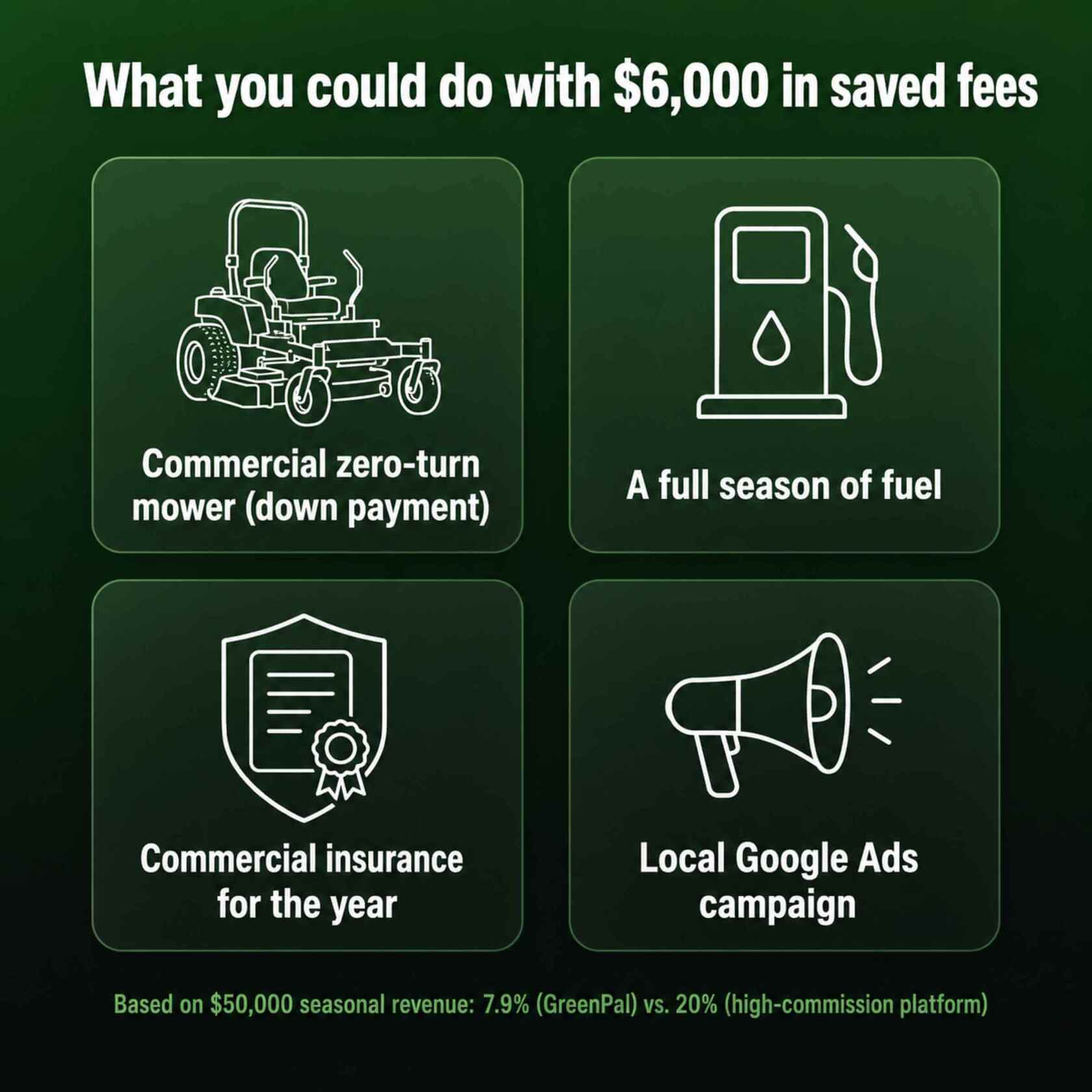
On a $50,000 season, the difference between 7.9% and 20% is over $6,000 in profit.
Beyond the fee structure, GreenPal includes operational tools that actually move the needle for route-based businesses:
Property assessment via Google Aerial and Street View: Quote accurately without driving out for an estimate
Automated recurring scheduling: Set up weekly or bi-weekly service and the platform handles the logistics
Route optimization: The GreenPal Pro vendor app builds the most efficient daily route, saving up to an hour of drive time per day
48-hour Stripe payouts: Funds are deposited within two business days of job completion and photo confirmation
Client portability: You can invite your existing customers onto the platform and use GreenPal's billing tools at no additional cost
On GreenPal, the client relationship belongs to you, not the platform. You're building a real customer base, not a platform-owned list that disappears if you ever switch apps. That distinction compounds significantly over time.
GreenPal currently operates across 250+ markets in 48+ states with more than 60,000 active professionals and over 1 million homeowners using the platform.
2. LawnStarter and Lawn Love
LawnStarter, which acquired Lawn Love, operates on an algorithmic assignment model. Rather than bidding, jobs are priced and matched to available providers in your area. That removes the estimating step, which lowers the barrier to entry for new operators.
The tradeoff is margin and flexibility. LawnStarter and Lawn Love charge 15-20% commission per job, and the algorithm sets the price, meaning you have no input if the system underprices a complex property. Properties with overgrown grass, difficult terrain, or unusual layouts often warrant a surcharge of 50-80%, and algorithmic pricing doesn't always catch these.
When the match quality is high, the platform delivers a steady flow of work without much administrative overhead. When it isn't, dispute resolution runs through a narrow five-day window with limited flexibility.
For new businesses that need volume quickly and are willing to trade margin for simplicity, LawnStarter is a reasonable starting point. For established pros with strong estimating skills and an existing client base, the commission rate is hard to justify once you've scaled past the early-growth stage.
For a side-by-side breakdown, see our GreenPal vs. LawnStarter comparison.
3. Thumbtack
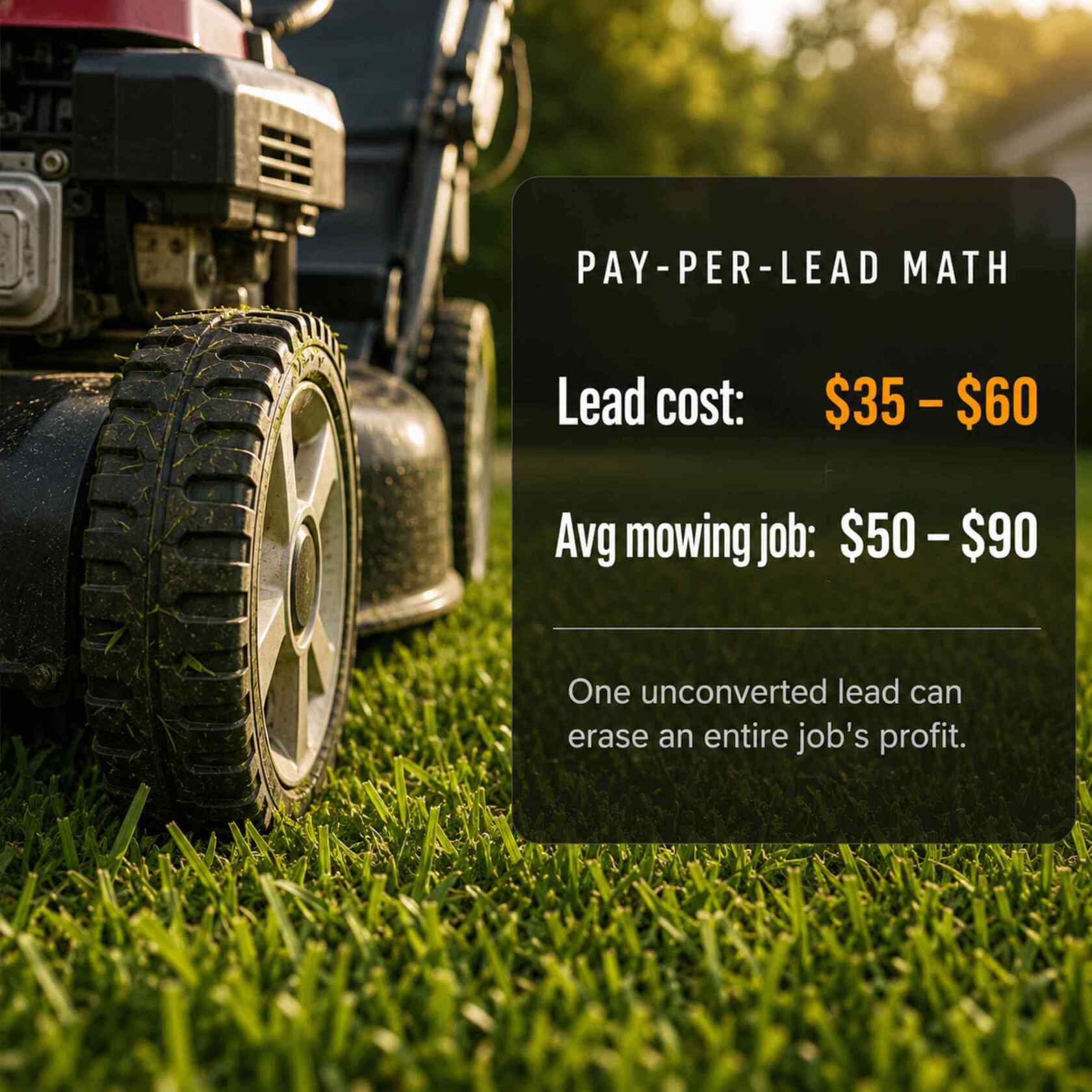
Thumbtack runs on a pay-per-lead model. You pay for the opportunity to contact a potential client, not for a completed job. Lead costs for standard mowing typically fall between $35 and $60. For specialized work like landscape design, irrigation, or commercial contracts, leads can exceed $200.
The economics work if your conversion rate is high and you respond fast. Industry data consistently shows that the first contractor to make contact wins the job most of the time, which means a slow response can multiply the effective cost of a lead several times over.
Thumbtack is better suited to high-ticket project work where one conversion justifies the lead cost. For recurring residential mowing, the math usually doesn't pencil out at $35-$60 per lead when the average job value is $50-$90.
4. Angi Leads
Angi, now integrated with HomeAdvisor, also operates on a pay-per-lead basis. Participation requires an annual membership of around $300 plus a minimum monthly ad spend starting at $300. That's a fixed cost floor before you've booked a single job.
Some contractors report customer acquisition costs well above $1,000 per booked client after accounting for unconverted leads. Angi makes the most sense for licensed contractors doing commercial work or specialized services with high enough project values to absorb that acquisition cost. For residential mowing routes, the overhead is disproportionate to the ticket size.
5. GigNGo
GigNGo (formerly Kickback) represents a newer model consisting of a flat monthly subscription with zero commission on completed jobs. You keep 100% of your earnings, and the platform provides a Google-searchable profile where you can post short-form video of your work, essentially a portfolio visible outside the app.
The limitation right now is market depth. GigNGo is still building provider and homeowner density in most areas, which means fewer inbound leads compared to established platforms. The subscription model makes the most financial sense for operators who already generate their own leads and primarily need a booking, payment, and profile visibility system.
Lawn Care Platform Fees and Features Compared
Platform |
Fee Model |
Effective Cost Per Job |
Recurring Scheduling |
Payment Speed |
GreenPal |
Commission |
~7.9% (5% + Stripe) |
Yes |
48 hours |
LawnStarter / Lawn Love |
Commission |
15-20% |
Yes |
Varies |
TaskRabbit |
Commission |
22.5% |
No |
Varies |
Thumbtack |
Pay-per-lead |
$35-$200 per lead |
No |
Direct |
Angi Leads |
Pay-per-lead |
$300/yr + $300/mo minimum |
No |
Direct |
GigNGo |
Subscription |
Flat monthly fee |
No |
Direct |
Which Platform Fits Your Lawn Care Business?
The right platform depends on what problem you're actually trying to solve.
Building a recurring residential route: GreenPal's commission structure, route tools, and recurring scheduling are built for exactly this use case. The satellite-based quoting, automated weekly scheduling, and route optimization make it the most operationally complete option for residential mowing businesses.
New to the business and need volume fast: LawnStarter's assigned-job model reduces complexity and gets you working quickly. The margins are lower, but the onboarding friction is also much lower. It's a workable starting point before transitioning to a lower-commission platform once you've built some operational confidence.
Doing specialized or high-ticket project work: Thumbtack or Angi can deliver qualified leads for design-build, irrigation, or commercial contracts where the project value is high enough to absorb the lead cost.
Already generating your own leads: GigNGo's subscription model may be the most cost-efficient option if you have a solid lead source and primarily need a professional booking and payment system.
Most established operations end up using more than one platform. A common setup is GreenPal for recurring residential work alongside Thumbtack for project-based jobs with higher ticket values.
Other Factors to Evaluate Beyond Platform Fees
Commission rates are the most obvious variable, but a few other factors deserve attention when evaluating any platform.
Client ownership: On some platforms, the client relationship belongs to the platform and disappears the moment you stop using the app. On others, you own that relationship and can take it with you. That distinction compounds significantly over time.
Dispute resolution: Understand the process before something goes wrong. Narrow resolution windows and rigid policies can cost you money on legitimate issues.
Pricing model fit: Hourly billing platforms are structurally misaligned with flat-fee lawn care. Make sure the platform supports the way you actually price jobs.
Market density: A platform with deep coverage in your area is worth more than one with a higher theoretical upside but thin local supply and demand. Check how active each platform is in your specific market before committing time to the onboarding process.
For current pricing benchmarks in your area, see our lawn mowing cost guide, which covers regional rates across dozens of markets.
Frequently Asked Questions
Which lawn care platform has the lowest commission rate?
GreenPal has the lowest commission of any major lawn care platform at around 5% per completed job. LawnStarter and Lawn Love charge 15-20%, and TaskRabbit's combined fees total 22.5%. The difference adds up fast: on a $50,000 season, GreenPal's lower rate translates to over $6,000 more in profit compared to a 20% commission platform.
Is TaskRabbit worth it for lawn care?
For most lawn care professionals, no. TaskRabbit charges 22.5% in combined fees, uses hourly billing rather than flat-fee pricing, and has no tools for managing recurring routes. Lawn-specific platforms offer better margins and more relevant features for the way the work is actually structured.
How much does LawnStarter charge lawn care pros?
LawnStarter charges 15-20% commission on completed jobs. Because they set the job price algorithmically, you also have no control over the rate, which can be a problem with complex or challenging properties. See our full LawnStarter reviews for more on how the platform performs in practice.
How does GreenPal make money from lawn care pros?
GreenPal takes approximately 5% of each completed job. The remainder is processed through Stripe, which adds its standard ~2.9% payment processing fee. There are no monthly subscription fees or sign-up costs to join as a provider.
How fast does GreenPal pay lawn care professionals?
Payments deposit within 48 hours of job completion and photo confirmation via Stripe. That fast payout cycle matters in a business with recurring weekly overhead like fuel, insurance, and equipment maintenance.
The Bottom Line on Lawn Care Platforms in 2026
The U.S. landscaping industry is projected to reach $188.8 billion in market size, with over 692,000 businesses competing for that revenue. With labor costs forecasted to rise 20% through 2029, platform fees are a direct input into whether your business is profitable.
Every dollar you give up to a platform is a dollar that doesn't go toward fuel, equipment, insurance, or your own paycheck. On a $50,000 season, the spread between a 5% platform and a 20% platform is over $6,000. Over a few years of growth, that gap funds a new mower, a second crew member, or a marketing budget that generates leads you own outright.
Choosing the right platform is one of the highest-leverage decisions a lawn care professional can make. If you're ready to run a leaner, more profitable operation built around recurring routes, GreenPal is a good place to start.
Get Lawn Care Near You

Check out these other Articles