|
This guide includes:
|
Fire ants have a bad reputation for their unsightly mounds, painful stings, and damage to lawn equipment. The best way to get rid of fire ants in the lawn is to follow a two-step method that involves broadcast bait and individual mound treatments.
First, spread broadcast bait granules throughout the entire lawn using a hand-powered spreader. Several days later, target individual mounds with a liquid drench or dry powder treatment. In this guide, we’ll show you when and how often to apply bait and explain why fire ant control requires continuous strategy.
What Are Fire Ants?
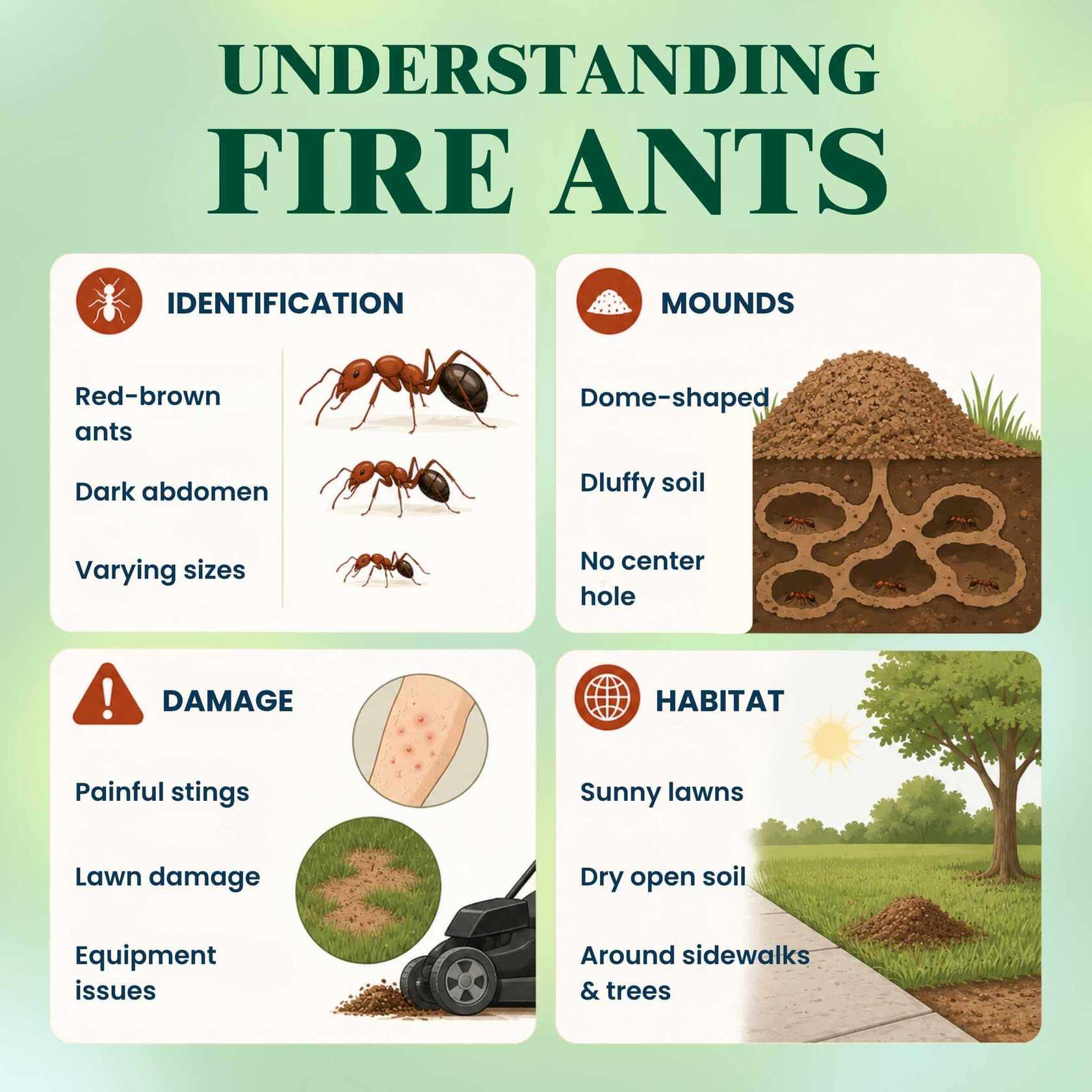
Red imported fire ants (Solenopsis invicta) vary in size, ranging between 1/16 to 1/4 inch long. They’re red-brown with shiny, dark abdomens, and have two bumps between the thorax and abdomen.
These pests are an invasive species introduced to the United States from South America decades ago, likely from cargo ships. They are common in the Southeastern United States, and are gradually expanding their territory north and west.
Note: Some colonies only have one queen, and some have multiple queens. To successfully control fire ants, the colony’s queen ant must be killed.
What Damage Do Fire Ants Cause?
Fire ants are a nuisance in the yard due to their painful sting, their large anthill, and the damage they can cause to lawn equipment.
Sting: Fire ants pose a threat to both humans and animals through their venomous, burning sting, which can leave white pustules on the skin. When their mounds are disturbed, they emerge rapidly to attack the intruder. Their venom, combined with the sheer force of numbers, can prove fatal to small animals or cause life-threatening allergic reactions.
Mounds: When fire ants nest in the ground, their activity becomes visible in the form of large mounds that may ruin a lawn’s aesthetic.
Damaged lawn equipment: Not only can their large mounds blunt lawn mowing blades, but fire ants can also cause significant electrical issues when nesting and chewing through the wires found in mowers, irrigation systems, and electrical boxes.
Why Are Fire Ants In the Lawn?
Fire ants prefer to nest in sunny, open spaces, including home lawns, fields, and next to sidewalks. They thrive in soil that is rarely disturbed and has access to food sources.
An underground fire ant colony can sometimes go unnoticed. However, you may see their ant hills appear a few days after rainfall as they escape the accumulating groundwater.
Fire ants may also nest in rotting logs and electrical equipment, around trees, and under pavement.
How Fire Ant Colonies Form and Spread
Fire ant colonies consist of three adult types: winged reproductive females (future queens), winged males, and worker ants (sterile females).
The reproductive females and winged males take flight and mate in spring and fall. The males die shortly after, and the reproductive females search for a place to establish a new colony and be its queen.
Signs of Fire Ant Activity in Your Lawn
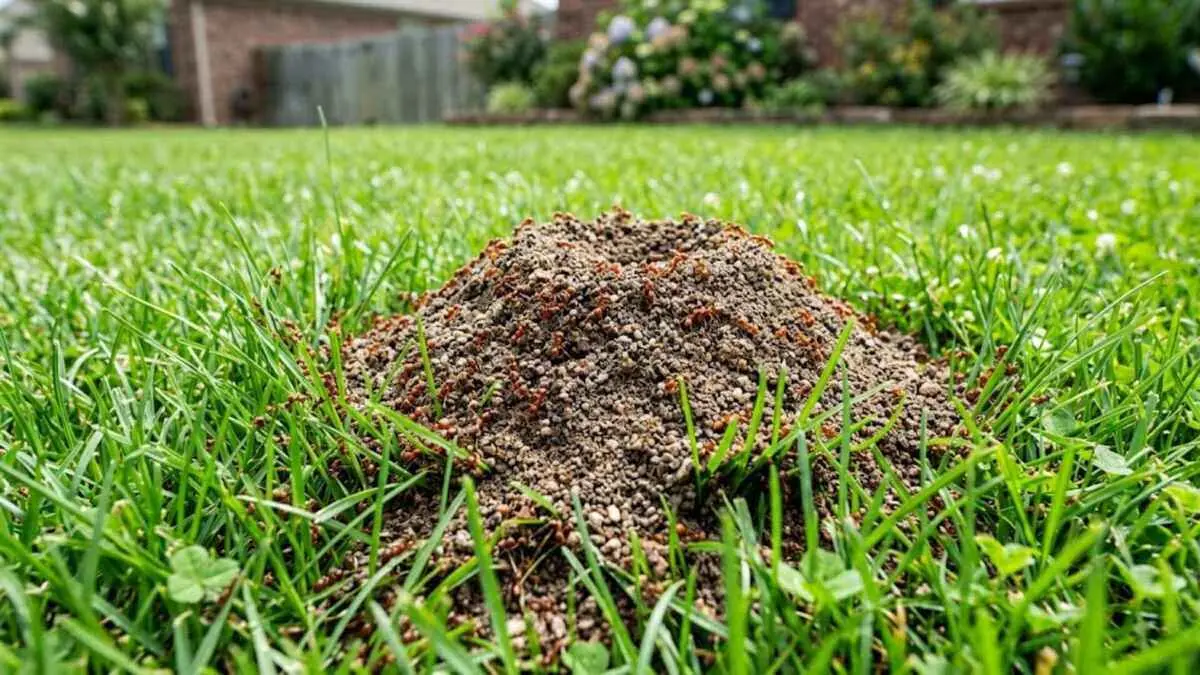
Fire ant mounds are the clearest sign of a fire ant colony in the lawn.
What Do Fire Ant Mounds Look Like?
Fire ant mounds are dome-shaped piles of loose, soft, fluffy soil. Unlike other ant and pest mounds, fire ant mounds have no opening hole in the center. Most mounds in home lawns don’t reach more than a few inches tall.
Think your mound problem is a mole or gopher instead? Here’s how to get rid of them.
Why Fire Ant Control Requires a Consistent Strategy
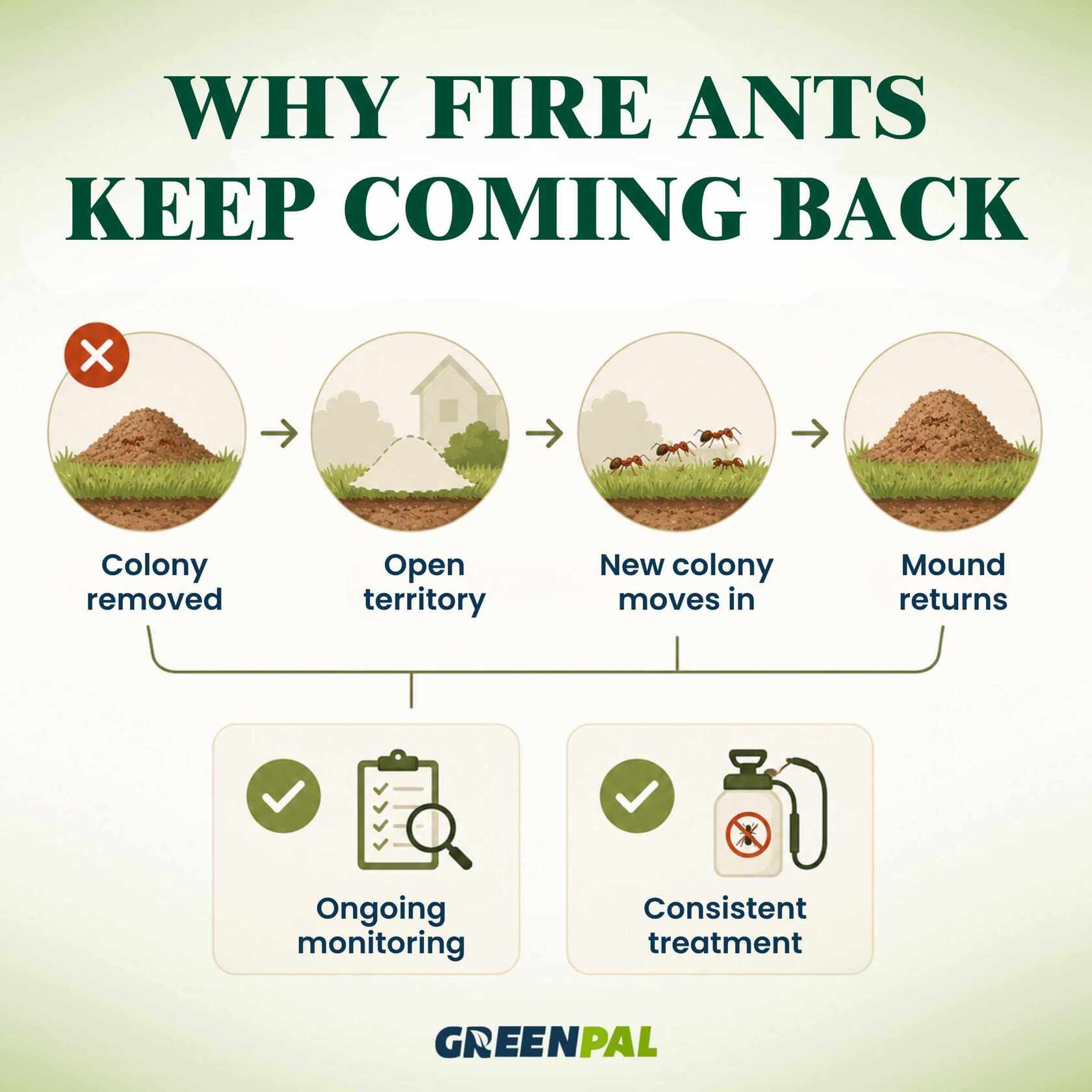
Here’s the hard truth about fire ants: a lawn without fire ants is attractive to fire ants. Why? Because when there is no competing colony, a colony is able to grow and thrive.
That’s why fire ant control is a consistent strategy. When one colony is destroyed, a new one may move in and take over the lease.
That’s why it’s also important to continuously monitor and treat small mounds. While a colony may be small and untroublesome for now, the lack of competition allows them to flourish.
The bottom line: recolonization is inevitable without ongoing management.
The Two-Step Method: The Most Effective Approach
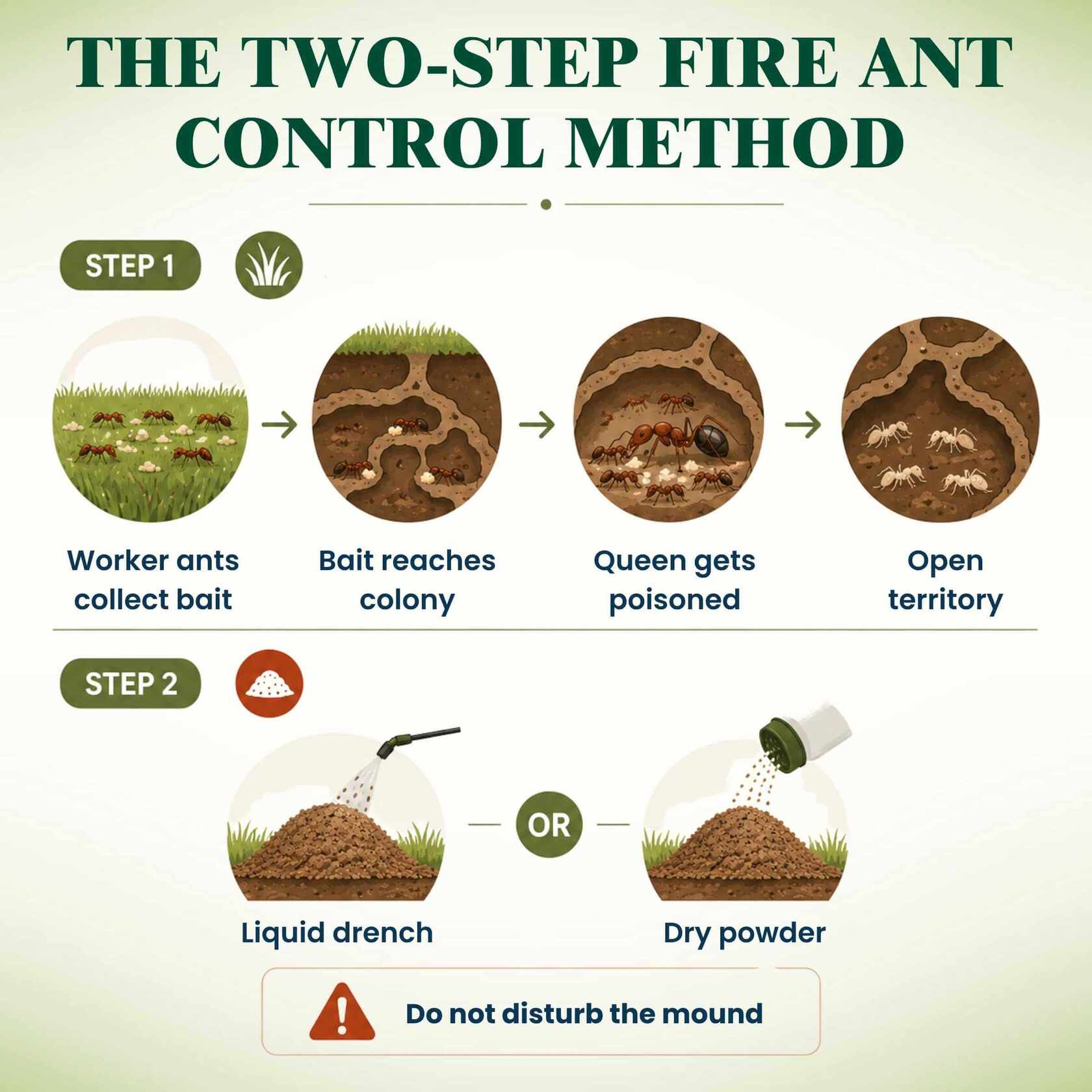
The best way to control fire ants in the lawn is to apply a two-step method involving broadcast bait and individual mound treatments. Your ultimate goal when treating fire ants is to kill the queen (or queens), because she is the only one that lays eggs.
Step 1: Broadcast Bait
Baits provide the cheapest, most effective control against fire ants. Where properly applied two to three times per year, baits provide 80 to 90% control.
Granular bait contains oil (or some other food substance) that fire ants find attractive and a small amount of insecticide. The insecticide must be slow-acting to allow time for the worker ants to share it with the entire colony.
Although you can use granular bait to treat individual mounds, it works best when applied throughout the entire yard as a broadcast treatment. Why? Because if you only individually treat large mounds, the small colonies that you can’t see will thrive due to less competition.
If you are applying bait as an individual mound treatment, do not apply it on top of the mound (the ants won’t find it there).
This guide covers how and when to apply broadcast bait in the later section How to Use Fire Ant Bait Correctly.
Step 2: Individual Mound Treatments
Treat individual mounds with a contact insecticide several days after applying the broadcast bait (this gives the foraging worker ants some time to bring the bait back to their colony.)
When applying a mound treatment, never disturb the fire ant mound. Disturbing the mound may prompt the worker ants to lead the queen or queens to safety via underground tunnels and establish new satellite mounds.
The two most common individual mound treatments are liquid drenches and dry powders.
Liquid Mound Drenches
Liquid drenches provide faster results than dry powders, but are less convenient to apply.
Depending on the size of the mounds, soak the entire mound with 1 to 2 gallons of mixed drench (which is usually a small amount of insecticide mixed with water).
Apply about one-fourth of the total volume to create a 10- to 12-inch barrier around the outside of the mound. This helps prevent the queen from escaping.
Apply the rest of the drench directly on the mound.
Dry Powder
Dry powder works more slowly than liquid drenches and is less effective, however, they’re more convenient to have on hand and apply when you spot a fire ant mound.
The most effective dry mound powders contain the active ingredient acephate. However, acephate has a very strong odor. Alternative active ingredients include deltamethrin or cyfluthrin which don’t smell as bad, but they work more slowly and not as effectively.
Sprinkle the instructed amount of powder on and around the mound.
Always follow label instructions, as some powdered products must be watered into the mound immediately after application.
How to Use Fire Ant Bait Correctly
Best Time to Apply Fire Ant Bait
The best time to apply fire ant bait is in early spring when the worker ants are actively foraging. You can improve your chances of control by applying again in midsummer and once more in early fall.
Apply bait when the ground is dry, the ground temperatures are between 70 and 90°F, and there is no forecast of rain for at least 48 hours.
To test whether the ants are foraging, use the potato chip test. Place a potato chip outside, and if there are active ants in the area, they’ll swarm to the chip within 30 minutes.
How to Apply Bait (Spreader Tips, Rate, Coverage)
Spreader: Apply ant bait using a hand-powered spreader. Broadcast spreaders, which are often used for fertilizer, will spread too much bait.
Rate: Most fire ant baits are applied at rates of 1 to 2.5 pounds per acre.
Coverage: Spread the bait over the entire lawn. Uniform coverage is not a requirement, and you do not need to apply the material in a crisscross pattern like you would a fertilizer.
How Long Does Fire Ant Bait Take to Work?
Depending on which bait you use, it can take 2 to 8 weeks to destroy the colony. More expensive options may work in less than one week.
Broadcast Insecticide Treatments for the Whole Lawn
Contact broadcast insecticides for fire ant control are more commonly used on athletic fields and golf courses than on home lawns. However, if you are treating other pests in addition to fire ants, such as white grubs, many broadcast insecticides can help target multiple pests at once.
Contact insecticides work by killing ants on contact, which is why uniform coverage is more important. Intended to be broadcast across the entire lawn, these insecticides are available in granular or liquid form.
Do not confuse granular insecticides with granular baits.
Granular baits contain oil or some other attractive food source and a small amount of slow-acting insecticides. The worker ants carry the bait back to the colony. On the other hand, granular insecticides do not contain food or attract foraging ants. Instead, the insecticide leaches into the soil and kills ants that come into contact with the treated soil.
Natural and Organic Fire Ant Control Options
Many natural and organic fire ant control options are available as alternatives to synthetic insecticides, such as:
Spinosad-Based Products: Spinosad is a natural substance made by a soil bacterium that is toxic to many common insect pests.
Hot Water Treatments: Pouring at least 3 gallons of scalding hot water (190ºF - 212ºF) on the mound has an elimination success rate 20 to 60% of the time, according to the University of Florida IFAS Extension.
Biological Control: Many organisms are parasitic to fire ants and can reduce their number over time, including phorid flies and the fungus Beauveria bassiana.
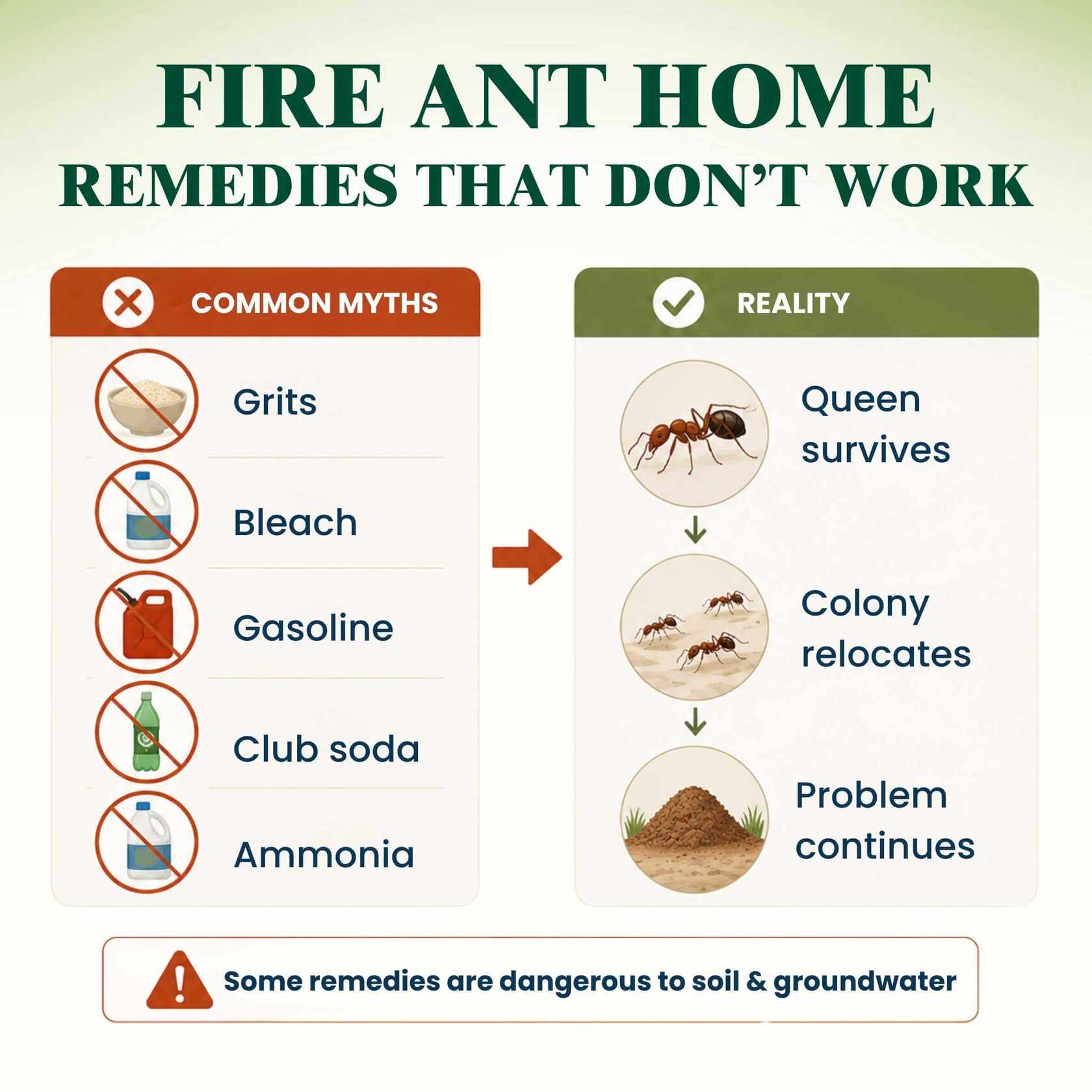
Fire Ant Home Remedies That Don't Work
Many home remedies have not been scientifically proven as effective fire ant control. Common ones passed around online include club soda, wood ash, grits, bleach, ammonia, and gasoline — and none of them reliably eliminate a colony.
The reason is simple: to destroy a fire ant colony, you must kill the queen. Most home remedies, at best, disturb the mound enough to cause the colony to relocate to a nearby area. The queen survives, and the problem moves rather than disappears.
Some remedies are based on outright myths. Uncooked grits, for example, are sometimes said to cause ants to swell and explode after eating them. But this is false. Fire ants can only ingest liquids, so they cannot eat grits at all.
Others are not just ineffective, but dangerous. Bleach, ammonia, gasoline, and other petroleum products can contaminate soil and groundwater and are hazardous to apply. They are not worth the risk, especially when proven treatments are inexpensive and widely available.
Frequently Asked Questions About Fire Ants in the Lawn
What Kills Fire Ants Instantly?
Liquid drenches work the fastest among reliable methods, but nothing truly eliminates a colony instantly. Many liquid drenches can kill the colony within a few hours when properly applied.
How Do Baits Spread Throughout the Colony?
The foraging worker ants pick up the bait granules and bring them back to their colony. Adult fire ants can’t eat solid food, so they have the larvae eat, digest, and liquefy the bait. The adult ants then pass the poisoned liquid food among the other ants to eat, eventually killing the colony and its queen.
What Are the Best Fire Ant Killers for Lawns?
There are many fire ant killers available for home lawns. Here’s a breakdown.
Bait ant killer:
Amdro Fire Ant Bait (hydramethylnon)
Advion Fire Ant Bait (indoxacarb)
Come & Get It Bait (spinosad)
Liquid mound drench:
Hi-Yield Bug Blaster (bifenthrin)
Bonide Eight Insect Control (permethrin)
Monterey Garden Insect Spray (spinosad)
Dry mound powder:
Ortho Orthene Fire Ant Killer (acephate)
BioAdvanced Fire Ant Killer (beta-cyfluthrin)
Bengal Ultra Dust 2X Fire Ant Killer (deltamethrin)
Broadcast insecticide (spray):
Fertilome Broad Spectrum Insecticide (bifenthrin)
Hi-Yield Bug Blaster (bifenthrin)
Ortho Bug B Gon Insect Killer for Lawns and Gardens (bifenthrin + zeta-cypermethrin)
Broadcast insecticide (granules):
Ortho Max Fire Ant Killer Granules (bifenthrin)
Triazicide Soil & Turf Insect Killer Granules (gamma-cyhalothrin)
Hi-Yield Kill A Bug II Lawn Granules (permethrin)
How Often Should I Treat My Yard for Fire Ants?
For effective fire ant control, apply bait granules one to three times per year. Apply the first treatment in early spring, with follow-ups in midsummer and early fall to prevent new mounds.
Are Fire Ants Dangerous to Pets and Children?
Yes, fire ants are dangerous to pets and children. These ants are aggressive, attack in swarms, and sting repeatedly. Their venom is painful and may trigger an allergic reaction, and in severe cases, may be fatal to small animals or young children.
Minimize Fire Ants With Professional Lawn Care
While a healthy, dense lawn does not completely prevent fire ants, it’s a strong deterrent. A thick canopy of tall grass shading the soil is less inviting than a thin lawn with dry, open areas baking in the sun.
Whether you’re battling fire ants in Killeen, TX or Gainesville, FL, consider hiring a local lawn care professional to strengthen your turf, or a professional landscaper to increase shade coverage.